
Advertising

2026 Digital Marketing Trends: Expert Predictions for Paid Media & Ecommerce

2026 Digital Marketing Trends: Expert Predictions for Paid Media & Ecommerce

Every January, the digital marketing world floods with predictions: some insightful, many recycled, and a few wildly off base. But 2026 feels different. We're not just watching incremental platform updates or minor algorithm tweaks anymore. We're witnessing fundamental shifts in 2026 marketing trends: how consumers discover products, how platforms deliver ads, and how marketers prove their work actually matters. The gap between brands that adapt and those that cling to old playbooks is about to become a chasm.

So we asked our team at Revel Marketing Partners where they think the industry is headed this year. What follows isn't speculation from the sidelines. These are predictions from the directors and leaders who are already navigating these changes with our clients, and who have strong opinions about what's coming next.

Revel Marketing Partners’ 2026 Digital Marketing Predictions

AI and Headless Commerce Are Reshaping the Shopping Experience

Kayla Faires, Founder & CEO:

"The future of digital marketing is about rebuilding infrastructure so you can move as fast as the platforms change. Two shifts are converging: headless ecommerce architectures, and agentic search systems where AI answers questions and makes recommendations before consumers reach your brand. Creative velocity and experimentation speed now determine ROAS, and legacy platforms are making it harder and harder to deliver. At the same time, discovery is shifting from queries to AI-mediated recommendations. Brands will compete less on keyword ownership and more on structured, machine-readable truth: clean product data, pricing logic, availability, and positioning that agents can interpret and recommend. As automation increases, judgment becomes the differentiator. The winners will pair flexible infrastructure with authentic brand building. Brands that actually stand for something and show their authenticity, while also leaning into new tech will compound advantages while others optimize yesterday's funnel."

Michele Keating, Account Director:

"Short-form video, AR try-ons, and creator demos won't just support ecommerce—they'll replace traditional PDPs. Live shopping will become the default, and UGC becomes the most trusted conversion asset."

AI-Powered Search and the End of Traditional Search Behavior

Abby Peterson, Director of SEM:

"2026 will mark the inflection point for paid search as AI advertising platforms fundamentally compress the user research journey. What once took 10+ searches now happens in a single ChatGPT conversation. Google Paid Search will remain a revenue powerhouse, but declining traffic volumes and intensifying CPCs will force a strategic reckoning: we can no longer afford to bid broadly. Success in this new landscape belongs to marketers who get ruthlessly selective with keyword targeting, double down on high-intent bottom-funnel terms, and maximize every click with precision audience strategies. The brands that will win aren't fighting this shift, they're adapting their strategies across both ecosystems while search is still profitable."

Brandon Elston, Paid Media Specialist:

"Brands that invest in GEO to appear in LLMs like ChatGPT & Gemini, will finally see a noticeable impact on purchases, especially from new customers. With the introduction of Universal Commerce Protocol (UCP) and direct integration of ChatGPT to Shopify, it is becoming increasingly more beneficial for consumers to shop on LLMs compared to search engines. This is because users can shop products across brands and make a purchase all in one ecosystem without browsing dozens of sites for inventory, products, or to find the best deals. A survey from Centerfield last year showed that the top 3 reasons users shop with AI are getting answers to product questions, comparing products or brands, & getting product recommendations, all top of funnel discovery type searches that could lead to discovering new brands and products."

Raw Creativity and Authenticity Will Beat AI Perfection in 2026

Paige Baugnet, VP of Client Services:

"I predict that we'll continue to see authentically raw and unpolished creative perform exceptionally well in 2026 as a direct counter to AI-generated perfection, particularly as consumers become increasingly skeptical about distinguishing real from fake content. In a digital landscape saturated with polished, algorithm-optimized visuals that all start to look eerily similar, people will actively crave authenticity and realness—the imperfect lighting, the shaky camera work, the unfiltered moments that signal genuine human creation. Brands that lean into this 'intentionally unpolished' aesthetic beyond the existing creator playbook will likely see stronger engagement and trust metrics, as audiences reward the vulnerability and transparency that comes with content that feels unmistakably human."

Jessica Shepherd, Chief Operating Officer:

"In 2026, the digital marketing industry will feel the real disruption not through job loss, but through the loss of excuses for mediocre thinking. As AI makes execution cheap, taste becomes a true competitive advantage—especially for beauty, fashion, and lifestyle brands where differentiation lives in nuance, not volume. The biggest brand risk won't be getting AI wrong; it will be sounding like everyone else who got it 'right.' That's why human review will increasingly serve as the new quality assurance layer—not to slow creativity down, but to protect brand distinctiveness in an automated world."

Marketing Mix Modeling, Diversification and the Shift to Incrementality

Amanda Moorhead, Account Director:

"2026 is going to be all about incrementality and accurate measurement for marketing. Last-click attribution isn't telling enough of the story, privacy changes are throwing a wrench into reporting, and relying on the same old methods is going to bring lackluster results. The brands that will unlock growth are those who can answer one critical question: 'What actually moved the needle?' That's why I'm excited to work with my clients on implementing MMM tools and diversifying their media mix. The future isn't about which touchpoint gets credit—it's about proving which dollars are truly incremental."

Gretta Schultz, Director of Paid Social:

"2026 is the year digital marketing finally gets its "infrastructure" right - better measurement, smarter and more consistent/reliable automation, and creative journeys that prioritize sustainable growth over quick wins."

Ashley Simpson, Director of Affiliate Marketing:

"We predict affiliate programs will prioritize channel diversification and robust partner vetting following high-profile removals like PayPal Honey, while navigating increased FTC enforcement under the Consumer Review Rule that rewards proactive compliance. We expect the industry to accelerate its shift from last-click attribution toward outcome-based models that credit partnership contributions, as both affiliate and creator marketing mature with greater emphasis on measurable ROI over vanity metrics. Affiliate publishers will continue expanding beyond Google Search dependence through multi-channel strategies spanning social platforms, direct traffic, and emerging opportunities like OpenAI's ChatGPT ads. Meanwhile, long-term creator partnerships will become the standard as brands recognize the value of sustained relationships, with emerging content formats and technologies requiring affiliate programs to evolve their partnership structures and compensation models accordingly."

What This Means for Your 2026 Strategy

The through-line in all of these predictions? 2026 rewards the strategic over the reactive. Whether it's demanding proof of incrementality, embracing rough authenticity over AI polish, adapting to compressed search journeys, optimizing for AI-powered discovery, or protecting brand voice in an automated world, the brands that will thrive are those willing to challenge their assumptions and evolve their approach. The tools are getting smarter, the platforms are getting more automated, and the consumer is getting more discerning. Your strategy needs to keep pace. At Revel Marketing Partners, we're not just watching these shifts happen. We're actively helping our clients navigate them. If any of these predictions hit home and you're wondering how to adapt your own marketing strategy, let's talk. Because the future isn't something that happens to you. It's something you build toward, one smart decision at a time.
Paid Search in 2025: Less Control, More AI, and the Lessons That Matter for 2026

If 2024 was the year Google introduced AI-powered campaigns, 2025 was the year they became the preferred path.

Google did not just roll out new features. It changed how paid search works. Automation moved from helpful to expected. Manual controls shrank. AI stopped assisting and started choosing. Google's message was consistent: Smart Bidding and AI-driven campaigns deliver better results. The problem? Automation didn't guarantee success. Advertisers with strong fundamentals saw impressive gains. Those without them lost ground quickly. The difference came down to understanding what Google's automation actually required, and what it couldn't fix.

2025 Was the Year AI Took the Wheel

Google’s direction was clear throughout the year: manual options are becoming increasingly limited, while AI-powered campaigns are taking center stage.

Enhanced CPC disappeared. Call-only ads got a sunset date. Campaign creation flows nudged advertisers toward automated formats. The message was consistent. This is where paid search is going.

At the center of it all was Google’s Power Pack approach: Performance Max, Demand Gen, and AI Max for Search.

Performance Max continued expanding as the all-in-one campaign type. Demand Gen evolved as a discovery-focused channel. AI Max entered as a Search feature suite promising broader reach through keywordless matching, automated copy, and dynamic landing pages.

For accounts with clean conversion tracking and strong first-party data, results improved. For accounts without that foundation, performance became harder to control.

AI did not fix broken setups. It amplified them.

The Cost of Automation

Google framed 2025 as a year of efficiency. Advertisers felt the cost side more clearly.

Average cost per lead increased year over year, with some verticals, such as retail, seeing 40–50% increases in CPCs over the past five years. While reporting improved, automated campaigns still required a level of trust many advertisers weren’t prepared to give.

Performance Max remained the clearest example. Even with improved reporting, the system required trusting algorithmic decisions over manual intervention. When results dipped, the solution was often to wait for the system to learn rather than make strategic adjustments.

Automation delivered scale, but it demanded surrendering control. In 2025, advertisers had to decide whether that tradeoff made sense.

Brands with authentic, involved, and vocal communities saw significant performance improvement. Brand communities also benefit the brand by providing endless UGC, instant feedback, and primed audiences to assist paid social efforts. 

What Actually Worked in 2025

AI Overviews Opened New Visibility, With Limits

Ads expanded into AI Overviews across more devices and regions. When they appeared, they mattered. These placements show up before users scroll and influence decisions early.

The challenge was consistency. Advertisers could not control when AI Overviews appeared or measure performance in a meaningful way. There was no way to optimize directly for them.

We treated these placements as incremental upside, not a strategy to chase. Strong fundamentals helped. Weak ones did not.

Performance Max Became More Practical

2025 was the first year Performance Max felt usable at scale.

Search term visibility improved. Channel-level reporting became clearer. Asset-level insights actually helped guide optimization. The controls that had always existed, negatives, demographics, search themes, finally had the transparency needed to use them effectively.

When paired with strong feeds, varied creative, and active management, Performance Max delivered. When treated as a set-it-and-forget-it solution, it consistently underperformed.

Creative Became a Performance Requirement

Google’s creative tools removed friction. Asset Studio and in-platform generation made it easier to produce volume quickly.

That mattered because automated campaigns need creative variety to work. Headlines, images, and video now directly influence performance.

The catch was quality. Some AI-generated creative worked well. Some felt generic or off-brand. In testing, assets generated without brand guidance often drove lower engagement and shorter performance windows. When creative inputs were structured and reviewed, we saw stronger CTRs and more stable conversion rates. AI helped scale output, but human direction made the difference.

The brands that performed best used AI for speed, not strategy. Human direction still matters.

Clean Data Became Non-Negotiable

AI-powered campaigns exposed data weaknesses.

Accounts with accurate conversion tracking and proper value assignment outperformed those without by margins exceeding 2x in many cases. Duplicate conversions, missing values, and weak signals led to inefficient bidding and unstable performance.

First-party data like Customer Match helped strong accounts get stronger. It couldn't fix broken fundamentals.

What Didn’t Work and Why It Matters

Blind Adoption of AI Max for Search

AI Max for Search launched in beta with significant buzz, but our early testing revealed clear limitations.

We saw irrelevant keyword matching, exclusions that were not always respected, and clunky setup flows. Automated copy sometimes missed brand intent entirely.

AI Max for Search showed promise as an expansion tool, not a replacement. Used carefully, it uncovered incremental volume. Used blindly, it created noise.

We will continue testing AI Max for Search in 2026, but with guardrails firmly in place.

Treating Performance Max as a Cure-All

Some advertisers tried to consolidate everything into Performance Max. Results usually suffered.

Performance Max excels at scale. It struggles with nuance. Brands with complex catalogs, promotions, or seasonal priorities still needed structured Search and Shopping campaigns.

The strongest accounts used Performance Max alongside other campaign types, not instead of them.

The Control Paradigm

The control paradox isn't going away. Google will continue removing manual options while adding "controls" that operate within automated guardrails.

The creative tension will intensify. As AI generates more assets, brand consistency becomes harder to maintain at scale.

AI optimizes for metrics. Brands care about positioning and voice. Those priorities do not always align.

Revel Interactive’s Bottom Line

2025 made one thing clear: automation is not the problem. Blind automation is.

The advertisers who succeeded weren't the ones who followed every Google recommendation. They were the ones who understood the systems, tested them critically, and intervened when automation couldn't account for business nuance.

2026 will reward that same approach. Clean data, varied creative, and strategic oversight will separate strong performance from mediocre results.

AI is powerful, but it still needs direction. The future of paid search isn't choosing between humans and machines, it's knowing how to use both well.

Sources

Honey Terminated from Affiliate Networks: What Brands Should Know

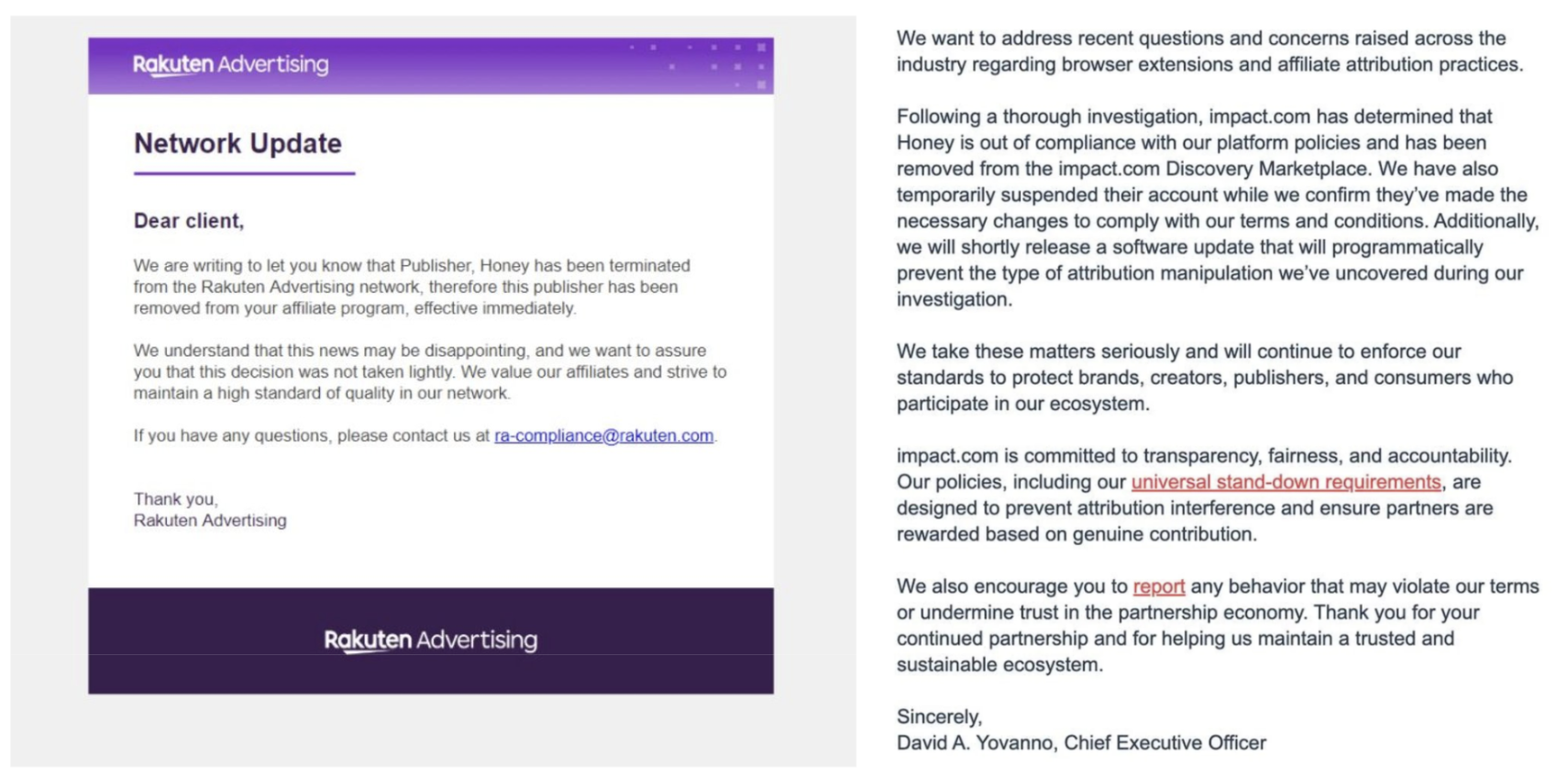
In January 2026, Honey (owned by PayPal) was removed from two major affiliate networks within the span of a few days. Rakuten Advertising terminated Honey from its network effective January 12, cutting off access to roughly 2,000 retail partners. Shortly after, Impact.com removed Honey from its Discovery Marketplace and temporarily suspended its account following a compliance investigation. 

These actions come amid growing attention on attribution practices and code usage behavior tied to browser extensions. While PayPal has since issued a response, the decisions by both networks point to a broader shift in how compliance is being enforced across affiliate programs. While Rakuten and Impact.com have taken action, other networks like CJ Affiliate have not commented, though industry watchers expect similar enforcement could follow.

What Happened

Rakuten Advertising notified advertisers on January 12, 2026 that Honey had been terminated from its affiliate network, effective immediately. Rakuten declined to comment publicly on the decision.

Impact.com followed on January 17, 2026, announcing that Honey had been removed from its Discovery Marketplace and that its account was temporarily suspended. According to Impact.com CEO David Yovanno, the action came after a thorough investigation that found Honey to be out of compliance with platform policies related to attribution practices. Impact.com stated that Honey’s suspension will remain in place while the company verifies that required changes have been made.

Together, these actions remove Honey from two of the largest affiliate ecosystems, significantly limiting its access to merchant partnerships.


PayPal’s Response

After Rakuten’s termination, PayPal issued a response. The company stated that it is aware of the actions taken regarding Honey and is working with Rakuten on a resolution.

PayPal explained that the issue stemmed from legacy code implemented prior to its acquisition of Honey. According to the company, the code impacted less than 0.1% of Honey’s traffic and has since been identified and deactivated. PayPal emphasized that Honey supports billions of shopping trips per year and reiterated its commitment to maintaining a fair and compliant ecosystem.

While PayPal maintains that the issue has been resolved, affiliate networks have continued to take enforcement action based on their own investigations and standards.


Why This Matters

Honey has faced declining revenue for many brands and ongoing challenges around enforcing code usage rules and maintaining program integrity. Networks are increasingly enforcing standards to protect advertiser trust and ensure consistent attribution.

For brands that relied on Honey, these removals may create short-term gaps in affiliate coverage or tracking. However, they also highlight the importance of understanding where affiliate value is truly coming from and how attribution is being earned.

More broadly, this situation reflects growing scrutiny of browser extensions and last-click attribution behavior across the industry.


What Brands Should Do Next

This is an ideal time to reassess your affiliate mix and shift efforts toward partners that offer more control and predictable performance. Brands should review where last-click conversions are coming from, especially at checkout, and confirm that attribution aligns with actual value provided.

If Honey played a meaningful role in your program, expect some redistribution rather than outright loss. Work with your network to identify partners that are likely to benefit and ensure tracking remains stable.

Consider partners like Checkmate, which provide:

  • Exclusive codes that cannot be leaked publicly

  • Easy-to-manage code controls

  • Reliable performance and tracking

Taking proactive steps now helps protect your program, reduce attribution risk, and maintain strong relationships with both affiliate partners and networks.

Revel Interactive’s POV

At Revel Interactive, we see this as part of a broader trend toward transparency and accountability in affiliate marketing. Networks are drawing clearer lines around compliance and partner behavior, and enforcement is becoming more consistent across platforms.

Brands that adopt partners with clear rules, reliable reporting, and measurable value contribution will be better positioned for stability and long-term growth.

Want more context? Read our original January 2025 coverage on Honey and affiliate compliance here.

Sources:

ChatGPT Ads Are Coming in 2026: What Marketers Need to Know Now

If you thought the Performance Max rollout kept you on your toes, buckle up. We're about to witness something we haven't seen since Google Ads launched in 2000: a completely new search advertising paradigm.

ChatGPT is testing ads internally right now, and the launch is imminent, likely Q1 or Q2 of this year. As someone who's been managing paid search campaigns through most major platforms evolution over the past 13 years, I can tell you this one feels different. And here's why we should all be paying attention.

Why This Matters More Than You Think

Let me start with the numbers that made me sit up straight: 800 million weekly active users. That's not total downloads or registered accounts, that's active weekly users engaging with ChatGPT right now. For context, that's roughly the population of Europe using this platform every single week.

Unlike when Google or Meta added new ad formats to existing platforms, OpenAI is building an advertising business on top of a product that users deeply trust with personal questions, financial decisions, and sensitive information. The second those ads feel intrusive or manipulative, users bolt. That constraint actually creates opportunity for advertisers willing to play by different rules.

What Makes Conversational Ads Different (And Why We Should Care)

I remember when smart bidding was introduced, when mobile-first indexing hit, when Performance Max forced us all to surrender control. Each time, we adapted. This is going to require something else entirely—a shift in mindset, not just methodology.

  • Traditional Search Ads: User types "project management software" → We bid on that keyword → Our ad shows → User clicks

  • ChatGPT Ads: User asks "I'm managing a team of 8 across 3 time zones and drowning in email threads, what do I need?" → AI understands context, intent, pain points → Sponsored recommendation appears in the answer

See the difference? We're not bidding on keywords anymore. We're bidding on actual human intent expressed in natural language. That's simultaneously exciting and terrifying.

The implications for how we structure campaigns, write ad copy, and think about targeting are huge. We've spent years optimizing for search queries. Now we need to optimize for conversations.

The Uncomfortable Truth About "Sponsored Recommendations"

Here's the part that's keeping me up at night, and I think we need to talk about it honestly: OpenAI is reportedly testing the ability to "prioritize sponsored content" within ChatGPT's actual responses. Not just sidebar ads, sponsored content in the answer itself.

Imagine a user asks ChatGPT: "What's the best way to treat a headache?" and the response prioritizes Advil because it's a paid placement, potentially burying information about when to see a doctor or alternative remedies.

That's a trust issue, plain and simple. And as advertisers, we have a responsibility to think about whether we want our brands showing up that way.

My take? The advertisers who win on this platform won't be the ones trying to game the system with the highest bids. They'll be the ones whose products genuinely solve the problem the user is asking about. ChatGPT's success depends on maintaining user trust, which means relevance isn't just a nice-to-have—it's existential for the platform.

The Revel Approach (What We're Actually Doing to Prepare)

At Revel Interactive, we're not waiting for an official announcement to start positioning our clients. Here's a glimpse of our playbook:

1. We're Recommending Microsoft Shopping Budget Now

Here's the strategic move: we're recommending clients allocate 5-10% of their paid search budget to Microsoft Ads Shopping. Why now? Because the setup barrier is practically non-existent. Microsoft Shopping can pull feeds directly from Google Merchant Center through a simple integration, no need to build an entirely new merchant account or duplicate all your feed work.

Why does this matter for ChatGPT? Given the OpenAI-Microsoft partnership, having an active presence on Microsoft Ads positions clients strategically for when ChatGPT advertising launches. Whether the ad platform integrates directly with Microsoft Ads or operates as a standalone system, clients with existing Microsoft Shopping campaigns will have cleaner data, established feeds, and the infrastructure to move quickly.

Budget constraints have kept many of our clients focused solely on Google, but the Microsoft integration removes the operational barrier. Now it's just about carving out a small testing budget to establish presence before ChatGPT ads go live and competition intensifies.

2. We're Working with Clients on Conversational Product Descriptions

Here's something we're starting to explore: AI-driven platforms need different feed optimization. Your product title "Women's Running Shoes Size 8" performs great in traditional Shopping. But ChatGPT users ask "What are comfortable running shoes for someone with flat feet who runs 5Ks?"

We're working with clients to test conversational product descriptions that answer questions, not just list features. It's a different skill set, closer to content writing than traditional feed optimization. Not every client is ready for this yet, but the ones who are will have a significant head start.

3. We're Setting Realistic Expectations with Clients

This is critical. We're not telling clients to shift budget from Google to ChatGPT in Q2. We're not promising this will be a silver bullet. What we are recommending is setting aside 5-10% of their Microsoft Ads Shopping budget as "experimental" so we're ready to test when beta access opens.

We learned this lesson with Performance Max: clients who had budget flexibility to test early got ahead. Clients who waited until their competitors had months of data struggled to catch up. 

4. We're Studying Conversational Search Patterns

Try this exercise: Go to ChatGPT right now and type in questions your customers ask. Not keywords, actual questions. See what comes back. Is your brand mentioned? Are your competitors? What content is ChatGPT pulling from?

We've been doing this for weeks across client verticals, and it's revealing. Some brands show up constantly. Others are invisible. That visibility gap exists before paid ads launch, which means there's organic opportunity right now.

The Three Scenarios We're Planning For

Nobody knows exactly how ChatGPT ads will launch, so we're preparing for three possibilities:

Scenario 1: Standalone Platform
OpenAI builds their own ads manager, similar to Google Ads or Microsoft Ads. We'd need to learn a new interface, new reporting, new optimization levers.

Scenario 2: Microsoft Ads Integration
ChatGPT becomes a new campaign type within Microsoft Advertising. This would be ideal. We already know the platform, our clients are already set up, and we could launch day one. Our bet? This is most likely given the OpenAI-Microsoft partnership.

Scenario 3: Hybrid Approach
Standalone platform that also integrates with Microsoft Ads for product feeds and some targeting. Honestly, this feels most realistic given how complex ad ecosystems work.

We're positioned for all three, with the heaviest emphasis on making sure Microsoft Ads infrastructure is solid across our client base.

What We’re Watching For (And You Should Too)

The next 90 days will tell us a lot. Here are our early warning signals that launch is imminent:

  • OpenAI job postings for "Advertiser Success" or "Agency Relations" roles

  • Microsoft Advertising webinars or documentation mentioning ChatGPT integration

  • Beta program invitations starting to circulate (these usually leak to Reddit first, honestly)

  • Updates to OpenAI's terms of service around commercial content

The moment we see two or more of these signals, we'll know we're weeks away, not months.

The Real Question: Should You Care Right Now?

It depends on your clients and your capacity.

You should absolutely care if:

  • You manage e-commerce clients (shopping integration is coming)

  • Your clients have strong Microsoft Ads performance already (lowest barrier to entry)

  • You have budget flexibility to test new platforms (first-mover advantage is real)

You can wait if:

  • Your clients are local service businesses without e-commerce (ChatGPT ads will skew toward retail initially)

  • Your clients have razor-thin margins (beta testing requires budget cushion)

What you absolutely should not do is ignore this until Q4 2026 and then panic when competitors have been optimizing for six plus months. We've seen this before with Performance Max, and it doesn't end well.

Final Thoughts: Staying Ahead Without Losing Our Minds

Look, I get it. Another platform, another set of unknowns, another thing to explain to clients who are still asking why their exact match keywords aren't actually exact anymore. The pace of change in paid search is exhausting.

But here's what I keep coming back to: we're watching the birth of conversational advertising in real time. Twenty years from now, we'll tell newer marketers about "the time before AI ads" the same way we talk about "before smartphones" or "before Performance Max."

The agencies that thrive won't be the ones with perfect information, none of us have that. It'll be the ones who stay curious, test intelligently, and help clients navigate change without overpromising or fear-mongering.

At Revel Interactive, we're approaching this the way we approach every major platform shift: informed optimism, strategic preparation, and a willingness to be wrong and adjust quickly. That's worked for us through every Google update, every Meta algorithm change, and every new feature rollout. No reason to change the playbook now.

Stay tuned. We’ll be sharing updates as we learn more. And if you want to talk through what this means for your specific clients? You know where to find your Revel team. This is what we're here for.

Sources:

2025 Paid Social Retrospective: Platform Winners, Creative Trends, and What's Driving Performance in 2026

The paid social landscape underwent major shifts in 2025, with creative formats evolving, platform competition intensifying, user behavior changing, and of course, the increasingly relevant role of AI in the everyday. As we get further into the new year, reflecting on last year's winners, losers, and understanding the key takeaways is paramount to staying competitive.

Platform Winners and Losers

TikTok really cemented itself as a performance marketing powerhouse in 2025. Previously viewed as more of an awareness/discovery platform, the ever-advancing algorithm, in combination with the robustness of TikTok Shop's interface, proved that the platform can and did drive meaningful conversion volume.

Meta proved resilient among competing platforms. Instagram Reels gained popularity as users embraced the endless scrollability format inspired by TikTok, and Sales campaigns continue to become more hands-off as a self-driving conversion engine.

LinkedIn and Pinterest also emerged as somewhat unexpected winners. LinkedIn further solidified its place as a B2B paid social powerhouse with meaningful ROI, despite its high CPMs. Pinterest quietly dominated purchase-intent audiences, with its keyword-based visual search and Google-like shopping features driving notable conversion rates for brands in fashion, home decor, and lifestyle verticals, more than previous years.

X and Snapchat struggled in 2025—with advertisers being hesitant about brand safety within X, and Snapchat losing its Gen Z audience as their preference moves to other platforms.

2025 Paid Social Creative Trends

True Authenticity

As AI-generated and AI-enhanced creative becomes more and more common in our feeds, users are responding more favorably to raw, authentic, human-made content. Audiences are hyper-aware of "faked" UGC and overpolished brand images. Genuinely real, unpolished content from actual customers saw engagement rates 3-5x higher than traditional creative. Users trusted micro-influencers over highly produced brand content.

Brands with authentic, involved, and vocal communities saw significant performance improvement. Brand communities also benefit the brand by providing endless UGC, instant feedback, and primed audiences to assist paid social efforts. 

Volume & Variation

Brands testing 20+ creative variations per month consistently outperformed those running less frequent (i.e., quarterly) refreshes. Paid social platform algorithms' appetite for novelty and newness meant fresh content, even if imperfect or less differentiated, beat stale winners.

2026 Paid Social Predictions

Algorithm-Guided Broad Targeting

As we've seen from Meta's Sales campaigns, platforms' AI-guided algorithms work best with broad targeting with few limitations. The new targeting is creative and landing page signals. There's potential for platforms to start taking more and more control away from advertisers and putting it into the hands of their own algorithms and technologies to drive results.

In-platform Social Commerce

TikTok Shop's success is leading more paid social platforms to improve their own native commerce capabilities, including Meta and Pinterest. The line between content and commerce is gradually disappearing, as we've seen with the swift integration of TikTok Shop items into creator-made content. The shoppability of ads is no longer a click to a website, they now fully circumvent websites altogether, with the shopping experience staying in the platform.

Authenticity Saturation

Brands will be in competition as to who can be the most authentic with their paid social content –the most real, in a landscape where users are valuing that more and more. Winners will emerge in terms of whose ads people actually trust and believe in, versus whose are performative and scripted.

The Bottom Line

As we move through 2026, success will come down to embracing platform evolution rather than fighting it. That means leaning into algorithm-guided broad targeting, investing in creative volume over perfection, building involved customer communities that fuel organic and paid social content, and preparing for the shift to native in-platform commerce.

The brands that will dominate aren't those clinging to old playbooks, they're the ones willing to let evolve alongside platforms' AI algorithms & focusing their energy on what algorithms can't replicate: genuine human connection and trust with their audiences.

Unlocking Growth with Demand Gen: Go Beyond Search Marketing to Find New Customers

Reimagining display and YouTube campaigns with Demand Gen for smarter awareness marketing.

Introduction 

At Revel, we see Google’s Demand Gen campaigns as the bridge between awareness and conversion—meeting over three billion monthly users, according to Google, right where they're exploring, not just searching. For brands ready to expand beyond search, Demand Gen unlocks new scale and reach, comparable to social platforms in Google’s own ecosystem. It’s a fit for clients with strong conversion tracking, visual-first assets, and a minimum $3,000/month budget. Brands that are starting to plateau in search and want to compete with the influence of social without paying inflated costs should explore Demand Gen as an option for top to mid funnel customer acquisition. 

Content & Audiences

Demand Gen thrives on visuals; matching creative to context helps our clients pair the right mix of video, imagery, and UGC depending on their vertical. For e-commerce, that means balancing lifestyle storytelling with product-centric assets; for B2B and services, it’s about weaving in trust, expertise, and social proof. Each industry requires its own creative rhythm—beauty moves fast with trend-driven content, while education and construction benefit from longer, credibility-focused narratives. Our role is to guide clients in building the right blend so their content feels native, engaging, and persuasive across YouTube, Discover, and Gmail.

Reaching the right audience is just as critical. Revel’s “audience stack” approach starts with lookalikes and custom intent, then layers on in-market signals, retargeting, and life events. Unlike broad affinity audiences, this precision keeps campaigns focused on high-intent prospects while still allowing Google’s AI to optimize. We structure campaigns around prospecting or retargeting, excluding converters to maximize efficiency that scales reach without losing relevance.

Why Demand Gen 

Demand Gen isn’t search—it’s mid to upper-funnel—and success means looking at the bigger picture: engagement, assisted conversions, and lifetime value. Early weeks are about learning and reach; months two and three bring stabilization as CPAs normalize, creative winners emerge, and campaigns scale. With clear benchmarks by vertical and a disciplined refresh cycle for assets, we help clients measure what matters most: sustained growth, not just short-term clicks.

Demand Gen captures audiences earlier in the journey. By combining Google’s owned inventory with Revel’s creative, targeting, and measurement expertise, we help clients harness Demand Gen as a growth engine. This isn’t about running ads for the sake of ads—it’s about building an adaptive, data-driven system that continuously learns, optimizes, and drives meaningful results. Reach out to the Revel team for more info.

Photo: © Brett Jordan from Pexels

The Ultimate Guide to Paid Ad Specs: Paid Search, Display, DemandGen, Paid Social, & Affiliate

The Ultimate Guide to Paid Ad Specs: Paid Search, Display, DemandGen, Paid Social, & Affiliate

In today's digital world, using ads effectively across various platforms is essential for boosting engagement and driving conversions. As online competition intensifies, leveraging a mix of paid search, display, social media, and affiliate marketing can help you reach your target audience and achieve your marketing goals.

This guide (updated as of August 2024) covers everything from image extensions, Performance Max, Responsive Display, uploaded banners, DemandGen, and YouTube on Google Ads to Meta platforms (Instagram and Facebook), TikTok, Pinterest, LinkedIn, Reddit, Snapchat, and affiliate marketing. Keep this index handy for quick reference and take your campaigns to the next level.

The Ultimate Q4 2025 eCommerce Calendar: Key Holiday Dates and Revenue Opportunities

The Ultimate Q4 2025 eCommerce Calendar: Key Holiday Dates and Revenue Opportunities

Just how high can the ceiling go? Cyber Week alone brought in $314.9 billion in global sales, according to Salesforce, helping push total holiday ecommerce spending to $1.2 trillion worldwide. In the U.S., core retail sales during the 2024 holiday season grew 4 percent year over year, reaching a record $994.1 billion and beating expectations from the National Retail Federation. One thing is clear: consumers are starting their holiday shopping earlier.

With 2025 looking just as competitive, brands need to plan smart, act early, and promote with purpose. Use this calendar to map your campaigns, align your creative, and make the most of every key date in Q4.

Microsoft vs. Google Ads: Which Platform Is Right for Your Business?

Microsoft vs. Google Ads: Which Platform Is Right for Your Business?

When it comes to digital advertising, the two major players that come to mind are Microsoft Ads and Google Ads. Both platforms offer robust tools for businesses to reach their target audiences online, but deciding between them can be a daunting task. In this guide, we'll dive into the key differences between Microsoft Ads and Google Ads to help you determine which platform is better suited for your business goals.